

ACLAE
Australian Consortium for Low-Altitude Economy


What is
Low-Altitude Economy?
-
Refers to economic activities within airspace below 1,000 meters
-
Encompasses both civil and commercial low-altitude operations
-
Bridges the gap between traditional aviation and ground-based infrastructure
-
Forms the foundation for next-gen air mobility and smart aerial ecosystems

Key Components
UAVs / Drones
- Agile aerial platforms for data, delivery, and inspection.
General Aviation
- All civil aviation operations outside scheduled airline services.
eVTOL Aircraft
- Electric aircraft for vertical take-off and regional air mobility.
UTM Systems
- Digital systems managing low-altitude airspace and traffic.
AI Flight Control
- Intelligent navigation, obstacle avoidance, and mission automation.
Geospatial Data
- Real-time aerial intelligence powered by GIS, sensing, and edge computing.
Real-World Applications
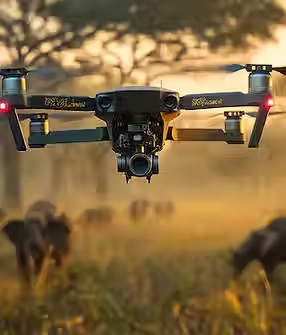
ACLAE champions the practical deployment of drone and low-altitude technologies across diverse industries. From emergency response to infrastructure monitoring, wildlife research, and localized inspections, our real-world applications demonstrate how aerial innovation is transforming operations, enhancing safety, and driving sustainable growth across the Asia-Pacific region.




Trends & Forecasts
.png)
The total number of drone flights will be around 60 million

The number of total flying hours will rise to over 15 million

There will be over 500,000 medical deliveries
.png)
Approximately 100 thousand patients will be transported using drones

Over 3.5 million flights will monitor protected areas, coastline and wildlife

Just over 1.5 million food deliveries will be made across Australia
.png)
Goods deliveries will reach 46 million, growing at a CAGR of 31%

Farmers will make almost 500,000 flights to monitor and support their crops

Around 310,000 drone flights will be used to support frontline policing

Almost 1 million passenger transportation flights per year

Surf life saving clubs will be supported by almost 80,000 annual drone flights

The mining industry will operate almost half a million drone flights
Challenges & Opportunities
Airspace Safety & Regulation
Balancing innovation and safety with adaptive regulations and standardized airspace management.
Data Privacy & Compliance
Transforming prototypes into viable, scalable, and profitable business models with clear use
cases.
Data Privacy & Compliance
Ensuring responsible collection, storage, and use of aerial data in line with global and local privacy laws.
Data Privacy & Compliance
Fostering international cooperation in technology development, regulatory alignment, and standard-setting.

Focus Areas

.avif)


10+
University Partnerships
15+
Countries & Regions
30+
Alliance Organizations
50+
Experts & Leaders
20+
Low-Altitude Projects
50+
Standards & Policies